Which Zones Can AI Cameras for Construction Sites Watch?
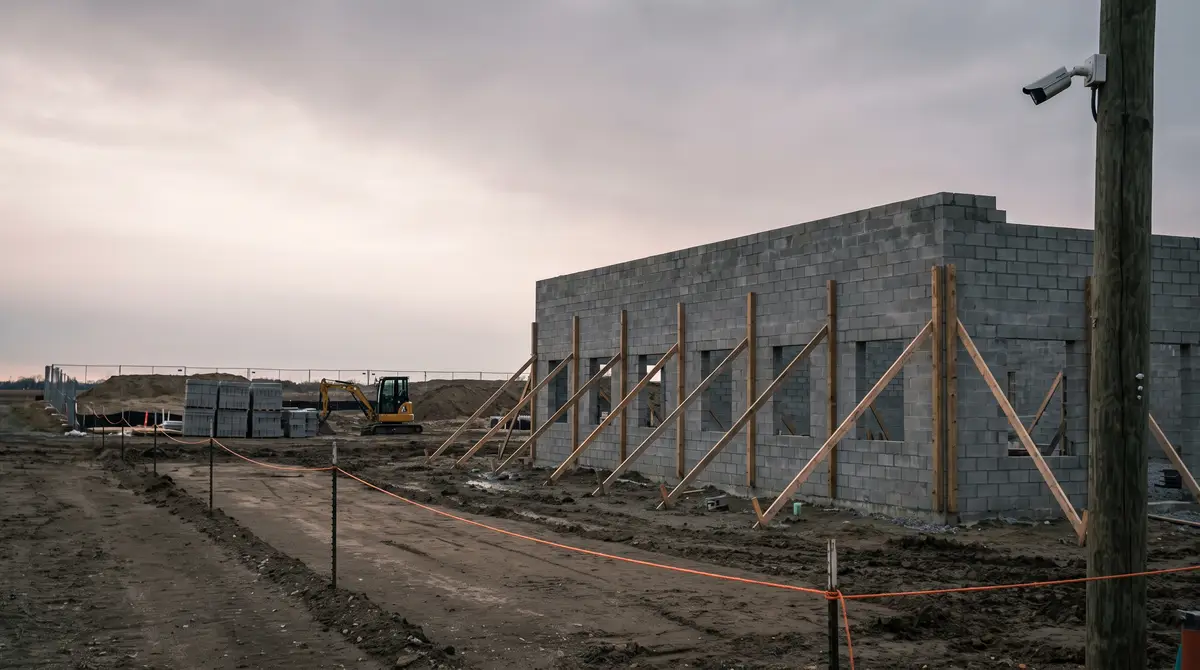
AI cameras for construction sites can alarm on zones that stay in one place while they’re in force and that OSHA keeps everyone out of, such as a barricaded debris drop. Most zones in Part 1926 let a crew in, so a person inside is a question for the foreman, and zones that travel with a load or a leading edge are a job for people.
A construction exclusion zone is an area around a hazard where an OSHA rule says who may be inside: under a debris opening, beside an unbraced wall, within a crane’s swing, back from an open edge. Most also say when it’s in force. A camera zone rule answers only part of that: whether anyone is there.
Two OSHA tests that decide which jobsite zones a camera watches
The decision is which zones on next month’s schedule go to a camera, and in what mode. It belongs to whoever owns the site safety plan, the safety director or the superintendent, and it should be made before a vendor draws the first zone on a camera view. Vendors in this category sell the feature as restricted-zone or hazard-zone enforcement. Two questions drawn from OSHA’s text sort every zone on a jobsite.
Does the zone stay put while it’s in force? A barricade, a wall under construction and a crane set up for the week all stay where they are. A fall zone is defined by the load hanging over it, and a control line is measured from an edge that advances every day. A camera zone is drawn once on a fixed view, so a zone that moves has left it by the afternoon.
Does the rule keep everyone out, or only people who aren’t doing the work? A camera zone rule asks one question: is anyone inside? Where the rule keeps everyone out, that’s the right question, and an alert means someone is where no one may be. Where the rule admits a crew, the answer is usually yes, and the person inside may be exactly who the rule allows.
Which OSHA zones AI cameras for construction sites can hold
The table sorts OSHA’s construction zones by both tests. “Who may be inside” describes each rule’s text.
| Zone and rule | Who may be inside while it’s in force | Stays put? | Camera treatment |
|---|---|---|---|
| Falling-object barricade, 1926.501(c)(3) | No employees. The barricade is one of three measures the rule allows, and hard hats are required in every case | Yes | Alarm whenever the barricade stands |
| Debris drop area, 1926.252(b) | Fully enclosed by barricades. No removal below until dropping stops above | Yes | Alarm during the drop |
| Demolition by balling or clamming, 1926.859(a) | No workers while balling or clamming is under way. At other times, only workers the operation needs | Yes, for one structure | Alarm during the balling window |
| Masonry limited access zone, 1926.706(a) | Only employees actively building the wall | Yes, until the wall is supported or braced | Alarm after the crew leaves. A heads-up to the foreman during the shift |
| Crane swing area, 1926.1424(a) | Marked to keep employees out. One who goes in where the operator can’t see first makes sure the operator knows | Yes, while the crane stays set up | A heads-up during lift hours |
| Roof warning line, 1926.502(f) | Only employees doing roofing work between the line and the edge | Yes, while roofing goes on | Alarm after the crew leaves |
| Controlled access zone, 1926.502(g) | Not named in (g)(1), which only restricts access. For overhand bricklaying, only that work and related work | No. The line is measured from the edge | A person’s job |
| Fall zone under a load, 1926.1425 | Only workers hooking, unhooking or guiding the load, making its first attachment, operating a concrete hopper or bucket, or receiving it as it lands | No. The load defines it | A person’s job |
| Safety monitoring system, 1926.502(h) | Not a zone: a competent person watching others | — | No camera can be the monitor |
Three rows close the area to everyone, and all three stay put. Those are the zones where a camera alert means what it says. Of the falling-object measures, only the barricade leaves an area for a camera to watch. The rule also lets an employer choose toeboards, screens or guardrails, or a canopy.
Two of the rows a camera can’t take are about falls from height. The controlled access zone’s control line has to sit 6 to 25 feet from the leading edge (precast concrete erection has its own range), so as the deck advances, the line has to follow it. OSHA’s safety monitor rule in 29 CFR 1926.502 names a person. The monitor is a competent person on the same walking or working surface, “close enough to communicate orally” with the worker, with no other duties that pull their attention away. According to the Bureau of Labor Statistics, 1,034 workers died in private construction in 2024. Falls, slips and trips caused 389 of those deaths, and 95.9% of the 389 were falls to a lower level.
Alarm, schedule, heads-up or a person: what each option costs
| Option | Fits a zone that… | What an alert means | What it costs to run |
|---|---|---|---|
| Alarm while in force | Stays put and keeps everyone out | Someone is where no one may be | Few alerts, each worth acting on. Redraw it whenever the barricade moves |
| Alarm after the crew leaves | Stays put, admits a crew, and stays hazardous once they go | Someone is there when no crew is | A schedule that tracks the work plan. Silent all shift by design |
| Heads-up during the shift | Stays put and admits a crew that is rarely inside | Someone is inside, and the foreman decides if they belong | Many alerts, most of them the crew. Useless where the crew works all day |
| A person | Moves with a load or an edge, or a rule names a person | — | A spotter, signal person or safety monitor on every shift |
Only the last row puts a person on every shift. Every zone a camera can take still needs a camera with a clear view of the whole zone, a person to answer its alerts, and someone to redraw the zone when the barricade or the camera moves. The scheduled options add one more cost that is easy to miss: the schedule has to change when the work plan does, or the alarm arms over a crew that is running late.
The rules, in order:
- Alarm while it’s in force if the rule keeps everyone out and the zone stays put: a falling-object barricade where you chose to barricade, a debris drop area while dropping, a demolition area while balling or clamming.
- Alarm after the crew leaves if the zone admits a crew and the hazard outlasts the shift: a limited access zone beside a wall that isn’t braced yet, the strip between a warning line and a roof edge.
- Add a heads-up during the shift only if the crew is rarely inside and someone will look within minutes: a limited access zone on a wall the masons build from the scaffold side, a crane’s swing area.
- Leave it to a person if the zone moves or the rule names one: a controlled access zone, a fall zone, a safety monitor.
Sorting one month on a mid-rise jobsite
Consider a hypothetical four-story building in month three. The site and its schedule are invented for illustration, and every dimension comes from the rule cited.
A 20-foot block wall, 160 feet long, goes up on the west side of the site, scaffolded on one face. Its limited access zone is set up before the first course: 24 feet deep (the wall’s height plus four feet) along all 160 feet, on the side without scaffolding. A crawler crane sets roof joists from the north side for two weeks. On level 3, the crew clears scrap and formwork offcuts by dropping them through a floor opening without a chute. The area below is barricaded 42 inches high, 6 feet back from the projected edge of the opening. Roofers work the low-slope roof of the one-story wing behind a warning line 6 feet from the edge, and 10 feet back on the edges perpendicular to the way the roofing machine travels. Decking crews lay metal deck at the leading edge on level 4.
| Zone | Rule | Treatment this month |
|---|---|---|
| Debris drop area, below level 3 | 1926.252(b) | Alarm during the drop crew’s hours |
| Wall’s limited access zone, 24 ft × 160 ft | 1926.706(a) | Heads-up to the masonry foreman by day. Alarm after the crew leaves, until the wall is braced |
| Crane swing area, north side | 1926.1424(a) | Heads-up during lift hours. Redrawn when the crane walks to its next pick |
| Warning-line strip on the wing roof | 1926.502(f) | Alarm after the crew leaves, if a camera can see the roof at all |
| Control line at the level 4 deck edge | 1926.502(g) | People |
| Fall zone under each joist bundle | 1926.1425 | People |
Six zones, and a camera takes four of them, but only one as a straight alarm.
What the 2013 Tennessee wall collapse says about alerts during the shift
On April 18, 2013, a block wall under construction fell on a jobsite in Tennessee. According to NIOSH’s investigation report, FACE 2014-02, it killed a 24-year-old laborer who was caulking the wall’s expansion joints and a 37-year-old pipefitter installing sprinkler piping in a trench next to it. A 46-year-old utility foreman was injured. NIOSH lists inadequate bracing among the contributing factors. Its recommendations include developing and implementing a restricted or limited access zone.
None of the three was laying block, and the pipefitter’s work wasn’t on the wall at all. The rule admits only the crew building the wall, so the people it exists to keep out are trades like his, with work beside the wall during the hours it goes up. That’s the case for the daytime heads-up. An alarm armed only after hours would have stayed silent that day, because the wall fell during the workday, with all three at work near it.
The heads-up only works if the zone is usually empty. Where masons build from the scaffold side, away from the zone, a person in it is worth a look. Where crews work on both faces all day, the alert fires constantly, and the foreman learns to ignore it.
Questions to settle before a vendor draws your first zone
- Which zones on the schedule keep everyone out, and for which hours? Those are the alarms. Everything else needs one of the other three treatments.
- Who gets each crew-only alert, and can they look within minutes? A heads-up nobody reads is worse than none, because it trains the site to ignore the camera.
- Who redraws a zone when a barricade moves or a camera goes up a floor, and how fast? A zone drawn for last week’s barricade watches the wrong ground.
- Does a camera see the whole zone, including the far end and the hours after dark? A 160-foot wall zone needs a view of all 160 feet, and jobsite light often goes off with the crew, so remember that video analytics at night sees a different image.
- What does “restricted zone enforcement” mean in the vendor’s product: someone inside, or someone who shouldn’t be? Ask to see what happens when the crew walks in.
Running jobsite zone rules on existing cameras
Nsightify’s Physical Safety includes two ready-to-run detections for this: entry into a restricted machine area (a person crossing into an exclusion zone around active machinery or a construction hazard) and restricted-area dwell. Both answer the question every zone rule asks: is someone inside? In general industry, the same detection watches zones around fixed machinery, covered in camera zone monitoring around machine guarding. The after-hours site falls to Perimeter Security’s intrusion into a restricted zone and after-hours zone entry.
Detection scheduling makes the treatments above practical. Any detection can be restricted to a shift, a night window or a weekend, and the customer chooses whether evidence is still captured outside the window. A wall’s limited access zone can stay quiet while the masons work and alert once they’ve gone. When a barricade moves or a camera is relocated, the customer redraws the zone, and the Nsightify team can help. Camera tampering flags a camera that has been obstructed, defocused or repositioned as the building rises. PPE compliance can check for hard hats at a barricade line, within what PPE detection verifies and what it cannot. Alerts reach the foreman through the channels the team already uses.
Zones that move with a load or an edge, and the safety monitor’s job, stay with the people on the deck and under the hook.
Frequently asked questions
What is the OSHA limited access zone for a masonry wall?
Under 29 CFR 1926.706(a), it is an area set up before a masonry wall goes up, on the side that will have no scaffolding. It is as deep as the wall’s height plus four feet and runs the wall’s full length. Only employees actively building the wall may enter. It stays until the wall is adequately supported, or, for a wall over eight feet, until it is braced.
What is the difference between a controlled access zone and a warning line?
A warning line, under 29 CFR 1926.502(f), marks off a roof edge during roofing work: at least 6 feet back, or 10 feet on edges perpendicular to the direction mechanical equipment travels. Only employees doing roofing work may be between the line and the edge. A controlled access zone, under 1926.502(g), is measured from a leading edge, 6 to 25 feet back (precast erection has its own range), or 10 to 15 feet from an overhand bricklaying edge, so it has to follow the edge as the work advances.
What are OSHA’s barricade requirements for a debris drop area?
When debris is dropped through holes in a floor without a chute, 29 CFR 1926.252(b) requires the area it lands in to be completely enclosed by barricades. They stand at least 42 inches high and at least 6 feet back from the projected edge of the opening above. Warning signs go up at each level, and no one removes debris below until handling stops above. Because the rule closes the area off completely while debris is dropped, a camera can alarm on it.
Can AI cameras do construction site safety monitoring?
They can alert when someone enters or lingers in a fixed zone, such as a barricaded drop area, and they can do it on a schedule. They can’t be the safety monitor OSHA describes in 29 CFR 1926.502(h): a competent person on the same walking or working surface as the workers, close enough to talk to them, with no other duties that could take their attention from monitoring. Zones that move with a load or a leading edge also stay with people.
What does exclusion zone monitoring on a construction site detect?
Presence. A camera zone rule detects a person inside an area drawn on the camera’s view, or one who stays longer than a set time. In a zone OSHA keeps everyone out of, presence is the whole question. In a crew-only zone, such as a masonry limited access zone, the person inside may be the crew, so the alert should go to someone who knows the crew.
Sort next month’s zones with the two tests, then book a Physical Safety demo to see a barricade alarm and an after-hours wall zone set up side by side.
More on this from Nsightify: PPE detection and hazard-zone monitoring.


See Nsightify in Action
We're onboarding a limited number of pilot partners. If you're an operations or security leader in construction, warehousing, or manufacturing — let's talk.