Machine Guarding Restricted Area: Where Optical Detection Fits
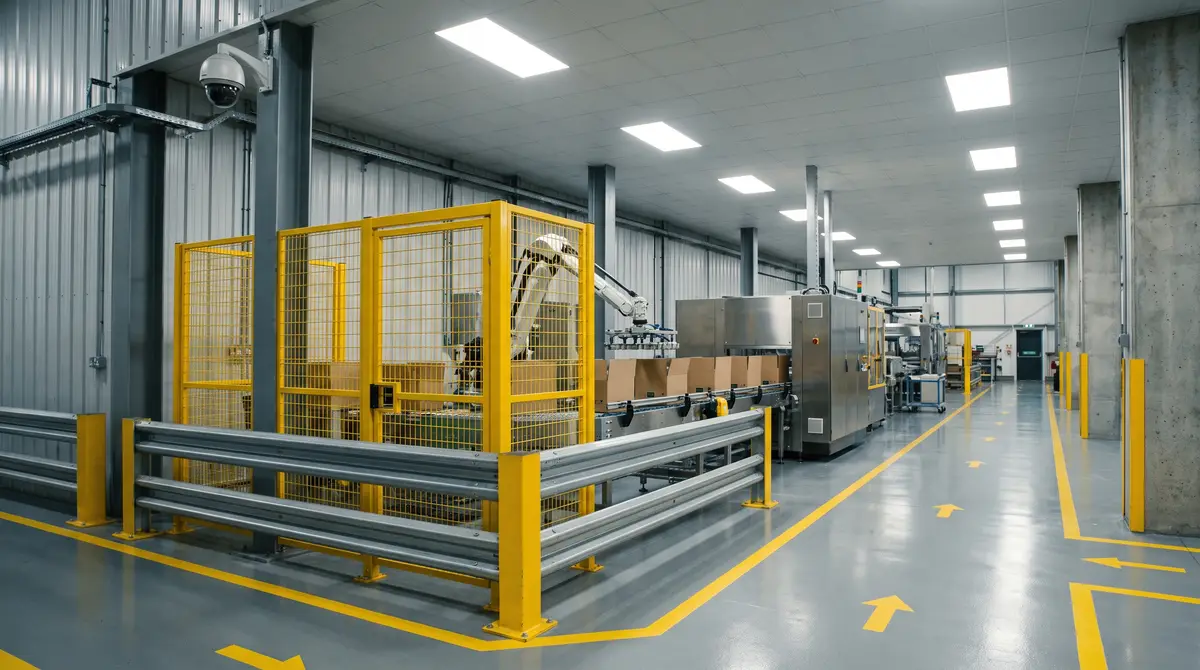
A maintenance technician steps over a painted yellow boundary line to clear a minor cardboard jam on an active packaging line. If the interlock is bypassed or the safety light curtain was never reached, the facility’s only record of the near-miss is the one someone chooses to write down. The gap between mechanical guarding at the point of operation and supervisory visibility across the wider work cell is where severe industrial injuries happen.
Physical machine guards are engineered to stop mechanical motion when a barrier opens or a light curtain breaks. What they cannot do is tell an operations manager that workers routinely step inside the hazard perimeter during active cycles, that an interlock latch was defeated with a zip tie, or that a forklift staged material within the swing radius of a robotic arm. Understanding where optical detection fits alongside federal safety mandates transforms machine safety from a reactive compliance checklist into continuous operational oversight.
The problem with relying solely on physical machine guards
Federal regulations governing machinery hazards are among the most strictly enforced standards in general industry. Under the Occupational Safety and Health Administration standard 29 CFR 1910.212(a)(1), employers must provide one or more methods of machine guarding to protect operators and other employees from hazards created by point of operation, ingoing nip points, rotating parts, flying chips, and sparks.
Despite decades of regulatory enforcement, machine guarding failures remain a persistent operational crisis. According to published enforcement data from OSHA, standard 1910.212 consistently ranks among the top ten most frequently cited workplace safety violations nationwide, generating thousands of citations and millions of dollars in penalties across manufacturing and warehousing sectors every year.
Point of Operation
Covered by OSHA 1910.212 barrier guards and hardwired E-Stop circuits. Halts motion when physical contact occurs.
Perimeter Hazard Zone
Unmonitored until a physical breach occurs. Workers routinely step inside perimeter lines or defeat interlocks during active cycles.
Material Staging Buffer
High-traffic loading aisles and pallet staging lanes. Shared space creates recurring blind-corner and crush hazards.
The human toll behind those citations is specific. OSHA’s Machine Guarding eTool states that workers who operate and maintain machinery suffer approximately 18,000 amputations, lacerations, crushing injuries, and abrasions, plus over 800 deaths, per year.
The underlying problem is not that physical guards fail to work when installed properly. The problem is that physical guarding operates under a binary mechanical assumption: either the guard is intact and closed, or the emergency circuit trips and the machine halts. Physical guards provide zero telemetry about the human behaviors, staging bottlenecks, and operational shortcuts that precede a catastrophic breach.
Why the usual approach falls short
Most industrial plants manage machinery safety through three traditional mechanisms: fixed barrier guards, presence-sensing safety devices (such as optical light curtains and pressure mats), and periodic supervisory walkthroughs. While each serves a distinct engineering function, relying on them as the sole safety oversight mechanism creates major operational vulnerabilities.
1. The interlock defeat paradox
When an emergency stop or safety light curtain trips, the machine halts abruptly. In high-speed automated packaging, stamping, or palletizing cells, an unexpected line stoppage causes product jams, requires manual indexing, and creates production downtime.
When operators face aggressive shift quotas, the friction of repeated line stops creates an incentive to defeat safety devices. Across fabrication plants and distribution hubs, workers tape over interlock switches, misalign optical sensors, or step around light curtains using structural framing to clear jams without cutting machine power. A physical guard provides no operational alert when it is being circumvented; it simply sits inactive while production continues.
2. The limitation of point-of-operation presence sensing
Under consensus standards such as ANSI B11.19-2019 (Performance Requirements for Risk Reduction Measures: Safeguarding and other Means of Reducing Risk), presence-sensing devices are engineered around strict stopping-time formulas. The distance between a light curtain and the hazard must be calculated based on the maximum approach speed of a human hand or body relative to the mechanical stopping time of the machine.
While ANSI-compliant light curtains protect the exact point of operation, they monitor only a narrow optical plane. They do not monitor the broader restricted envelope surrounding the machinery. If an unauthorized worker enters the perimeter staging zone behind an operator, or if a forklift mast intrudes into the overhead travel zone of an automated gantry, the light curtain remains completely unaware until an impact occurs.
3. Periodic walkthroughs capture static compliance, not dynamic risk
Safety audits and supervisor walkthroughs inspect machines in a static state. An auditor checks whether guards are bolted into place, whether emergency stop buttons are functional, and whether warning placards are visible.
What a walkthrough cannot capture is shift-dependent behavioral drift. Walkthroughs miss the third-shift habit of propping open a maintenance gate to speed up changeovers, the temporary placement of scrap bins inside a robot’s operational radius, or the routine entry of material handlers into designated machinery clearance paths. Because these behaviors occur intermittently, they remain invisible to management until an OSHA inspection or an injury investigation takes place.
What good looks like: Layered machine zone safety
Defensible industrial safety requires separating physical machine safeguarding from operational zone monitoring. The two systems do not compete; they operate at different layers of the safety architecture.
Floor Buffer Zone (Pedestrian & Vehicle Transit)
Restricted Perimeter (Machine Envelope Buffer (3–6 ft Radius))
Point of Operation (Physical Hazard Point (Nip Points, Dies & Robots))
Optical machine zone detection is the automated use of computer vision algorithms on existing overhead cameras to observe, classify, and timestamp unauthorized human or vehicle entry into designated virtual hazard perimeters around industrial equipment without altering machine electrical controls.
By establishing virtual perimeter boundaries around automated equipment, facilities create an early-warning observation layer that catches safety encroachments before a worker reaches the mechanical hazard.
| Evaluation Dimension | Active Safety Interlocks (ANSI B11.19 / OSHA) | Optical Zone Monitoring (Computer Vision) |
|---|---|---|
| Primary Purpose | Physical prevention of contact at point of operation | Operational visibility, near-miss logging, and early warning |
| System Action | Hardware-level electrical circuit break / Emergency stop | Real-time supervisory alert (SMS, dashboard, webhook) |
| Hardware Boundary | Hardwired into machine safety PLC / control relay | Connects to existing overhead IP/CCTV camera RTSP feeds |
| Reaction Horizon | Milliseconds (mechanical stopping distance) | Real-time observation of approach and dwell behaviors |
| Audit Capability | Binary trip counter (often unrecorded) | Structured metadata, timestamps, duration, and visual review |
| Operational Impact | Halts production immediately upon breach | Delivers early alerts without triggering line stoppages |
Step 1: Mapping the three concentric safety zones
A reliable machine vision safety architecture defines three distinct geometric zones around every automated or high-consequence asset:
- Zone 1: The Point-of-Operation Hazard Core. The physical envelope containing nip points, cutting heads, stamping dies, or robotic arms. This zone is strictly protected by OSHA-compliant physical enclosures, interlocked gates, and ANSI B11.19 light curtains.
- Zone 2: The Virtual Restricted Perimeter. A virtual polygon drawn around the machine footprint, extending three to six feet beyond the physical guard perimeter. This zone marks the boundary where only authorized operators should enter during active machine cycles.
- Zone 3: The Material Handling and Transit Buffer. The wider staging lane where forklifts, tuggers, and material handlers stage raw goods or remove finished pallets.
Step 2: Configuring contextual dwell and direction logic
Simple motion detection triggers an alert whenever any pixel changes in the frame, flooding supervisors with false alarms from vibrating machinery, flickering indicator lights, or passing shadows. Defensible computer vision uses object classification and spatial tracking to evaluate human and vehicle behavior contextually.
Pedestrian cutting through machine buffer zone to bypass main aisle or reaching past yellow perimeter. Directional tripwire detects encroachment immediately upon entry.
In an effective configuration:
- Instantaneous Crossing Alerts: Any unauthorized pedestrian crossing into Zone 2 while the equipment is operating triggers a high-priority alert.
- Directional Tripwires: Alerting distinguishes between an operator stepping away from a workstation and a passerby cutting across a restricted maintenance lane.
- Dwell Thresholding: Brief staging of materials at an infeed conveyor does not trigger an alarm, while extended human presence in a blind spot behind a baler generates immediate notification.
Step 3: Connecting alerts to operational coaching, not line stops
Optical zone monitoring does not wire into the machine’s electrical emergency stop circuit. This separation is deliberate. If camera software triggered an emergency stop every time an employee walked near a yellow line, the resulting production disruptions would lead operators to despise the system and find ways to obscure the cameras.
Instead, optical detection dispatches real-time alerts directly to floor supervisors, area leads, or automated visual warning beacons (such as an amber perimeter strobe). A supervisor receives a notification with the exact zone, timestamp, and visual snippet, allowing them to intervene immediately, correct the unsafe behavior, and determine why the worker stepped inside the restricted envelope. On a construction site, where most OSHA zones admit the crew doing the work, the same judgment decides which jobsite zones a camera can watch.
Step 4: Building a defensible near-miss audit record
In conventional safety programs, near-miss reporting relies on voluntary self-reporting. If a worker reaches into a running packaging machine to pull a loose strap and pulls their hand back safely, no report is filed. Management remains unaware that the hazard exists until an amputation occurs.
Continuous optical monitoring logs every virtual boundary encroachment as structured metadata. Plant managers can review monthly trend data showing which machines experience the highest frequency of perimeter encroachments, which shifts account for the most boundary breaches, and whether specific equipment designs encourage shortcut behaviors.
This empirical data is essential when reviewing compliance under OSHA’s warehouse national emphasis program, giving EHS leaders verified documentation of proactive hazard identification and corrective coaching.
Where Nsightify fits
Nsightify provides an AI video analytics platform that adds operational visibility to the standard IP and CCTV cameras industrial facilities already operate. Our software connects directly to existing camera infrastructure over RTSP and ONVIF streams, requiring zero camera replacements, proprietary edge sensors, or hardware retrofits to machinery.
Within our Physical Safety solution, Nsightify delivers allowlisted, ready-to-run detections purpose-built for industrial equipment environments:
- Entry into a restricted machine area: Detects and timestamps unauthorized human presence inside defined virtual machine envelopes.
- Restricted-area dwell: Monitors unauthorized lingering in blind spots, maintenance corridors, and hazardous equipment footprints.
- Unauthorized vehicle in a pedestrian zone: Identifies forklift or tugger encroachment into machine operator walkways.
- Person down: Immediately alerts on slips, falls, or sudden worker incapacitation near operating machinery.
- PPE compliance: Verifies high-visibility vests, hard hats, and required protective equipment before personnel approach hazardous work cells.
Existing IP Cameras
Connects to standard CCTV and IP cameras already mounted on facility columns and overhead trusses.
Nsightify Edge Inference
Processes video in volatile memory on site. Zero raw video streams leave the local network boundary.
Supervisor Alerts & Audit
Dispatches real-time SMS alerts, activates floor strobe beacons, and logs timestamped near-miss records.
Zero modifications to machine PLCs, electrical panels, control wiring, or certified physical E-Stops.
Nsightify operates purely out-of-band as an operational intelligence layer over existing camera streams. It maintains total physical and electrical air-gap separation from safety-rated machinery control systems.
The operational boundaries must be stated with complete engineering honesty. Nsightify is a supervisory monitoring and alerting layer. It does not act as an emergency stop device (E-Stop), does not wire into machine safety relays, and does not replace certified OSHA 1910.212 physical barriers or ANSI B11.19 presence-sensing devices.
Optical computer vision depends on camera sightlines, clean lenses, and adequate facility illumination. Blind spots behind heavy steel machine frames are a physical reality. That is precisely why Nsightify serves as an early-warning observation layer that strengthens real-time physical safety monitoring on existing cameras rather than attempting to substitute for mechanical safeguarding.
Organizations can deploy Nsightify via Nsightify Cloud or as a Zero Trust on-premises appliance for air-gapped manufacturing environments where proprietary production layouts and video feeds must never leave the facility network. Understanding how you don’t need new cameras to get AI video analytics allows plants to activate machine zone monitoring within days of commissioning.
Questions plant managers and safety leaders are asking
Does optical camera detection satisfy OSHA 1910.212 machine guarding requirements?
No. OSHA 1910.212 and ANSI B11.19 require physical barriers or certified presence-sensing safety devices wired directly into machine control circuits. Optical camera detection serves as an operational monitoring layer that observes perimeter encroachment and logs near-misses, but it does not replace certified emergency stop mechanisms.
What is the difference between a safety light curtain and optical zone monitoring?
A safety light curtain is a hardware-interlocked safety device that immediately cuts power to a machine when an optical beam is broken at the point of operation. Optical zone monitoring uses standard overhead CCTV cameras and computer vision to detect, timestamp, and alert supervisors when personnel enter a wider restricted perimeter, without interrupting machine power.
Can video analytics detect when a worker bypasses a physical machine guard?
Yes. By establishing virtual restricted polygons around machinery envelopes, video analytics detects human presence inside hazardous zones regardless of whether physical interlocks were defeated, bypassed, or left open during operation, generating an immediate supervisory alert and an audit record.
Does adding restricted machine zone monitoring require installing new cameras?
No. Standard IP and CCTV cameras already mounted overhead or along facility structural columns provide sufficient resolution and field of view for computer vision algorithms to track virtual boundary crossings over standard RTSP streams.
What to audit around your equipment this week
Improving machine safety does not require waiting for the next capital expenditure cycle or replacing operational machinery. Start by auditing the five highest-consequence automated machines on your floor—such as hydraulic balers, robotic palletizers, stretch wrappers, or metal stamping presses.
Check three operational realities on each machine:
- Inspect physical interlocks for bypass evidence: Look for magnetic overrides, taped sensors, or loose barrier latches.
- Observe actual operator clearance paths: Identify where workers step during routine clearing of material jams and whether painted floor lines match daily workflows.
- Map camera coverage: Verify whether existing overhead security cameras have an unobstructed line of sight across the machine’s restricted perimeter.
By establishing virtual restricted zones on existing cameras, you create an objective, continuous record of perimeter encroachments that allows supervisors to address unsafe habits before they result in a recordable injury.
If you are ready to add continuous zone monitoring to your plant floor, talk to our team about Physical Safety monitoring.
Keep reading:
More on this from Nsightify: PPE detection and hazard-zone monitoring.


See Nsightify in Action
We're onboarding a limited number of pilot partners. If you're an operations or security leader in construction, warehousing, or manufacturing — let's talk.