How Many Cameras Can One Person Monitor?
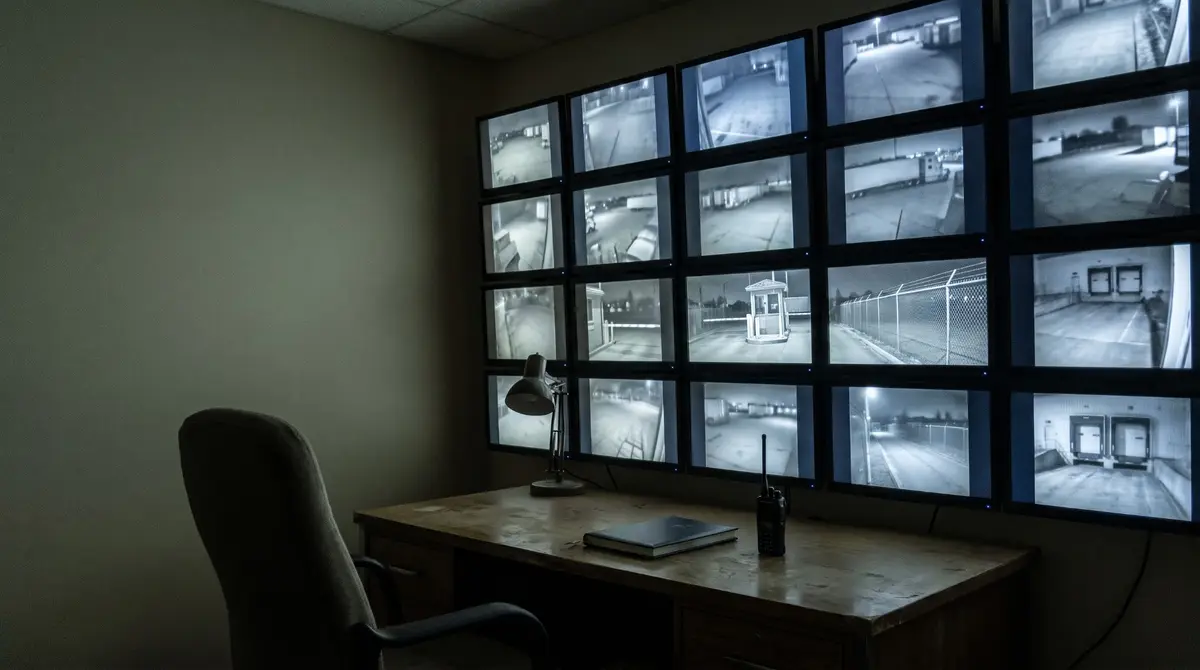
There is no research-backed number for how many cameras one person can monitor. The closest thing to a rule is a proposed guideline of 16 feeds per operator at once, or 9 when the scenes are busy. The famous answer, that operators miss 95% of activity after 22 minutes, can be traced no further than a 2002 security magazine.
Anyone who asks “how many cameras can one person monitor?” is usually sizing a desk: one officer and a monitor wall, or a second hire. The studies answer a better question, which is what that officer actually sees. In a 90-minute test of 73 people, 42 of them working CCTV operators, about half the target behaviors were caught, and the operators as a group didn’t fade.
The 22-minute statistic traces to a 2002 security magazine
The claim usually reads like this: an operator misses 45% of screen activity after 12 minutes, and 95% after 22. It often travels with a second claim, that US government research found attention fades after 20 minutes. The two have different origins.
The percentages appear in a 2008 University of Nottingham MSc dissertation on CCTV operator workload. It quotes them as “a study published in Security Oz magazine” and cites a 2002 article there, Buyer Beware. We couldn’t find that article, or any study behind the figures.
The 20-minute claim comes from a 1999 National Institute of Justice guide for schools by Mary W. Green of Sandia National Laboratories. On printed page 30 it describes tests Sandia ran for the Department of Energy about 20 years earlier. After 20 minutes, it says, “the attention of most individuals has degenerated to well below acceptable levels.” It gives no data and cites no study. The figures 12 minutes, 22 minutes, 45% and 95% appear nowhere in it.
| The claim | Earliest source we found | What we could verify |
|---|---|---|
| Operators miss 45% after 12 minutes and 95% after 22 | Buyer Beware, Security Oz, 2002, as quoted in a 2008 Nottingham dissertation | The dissertation’s quote. Not the article, and no study |
| Attention fades after 20 minutes | NIJ guide for schools, 1999, printed p. 30 | One sentence on uncited Sandia tests, with no figures |
What studies of operators actually measured
Controlled studies of people watching CCTV point to four things that decide what one operator catches. Time on the task and the number of feeds mattered least.
About half the targets get caught
In a 2015 study in Applied Ergonomics, Donald, Donald and Thatcher had 73 people, 42 of them full-time CCTV operators, watch 90 minutes of footage for four target behaviors. Across the group, about half the targets were caught, and false alarms were high.
Time on the task mattered less than the claim says
The 42 operators, as a group, showed no decline over the 90 minutes. Novices and generalist operators did decline. Specialists held steady for an hour and then improved, which Donald’s doctoral thesis on the same data suggests may be an end spurt, since participants knew the task was ending.
A 2014 study in PLOS ONE by Näsholm, Rohlfing and Sauer found the same about time. People who watched for 1 minute 50 seconds missed an unexpected event about as often as people who watched for 42 minutes 50 seconds.
People miss what they aren’t watching for
The PLOS ONE study showed 171 people a single high-quality screen. Eighty-four were infantry soldiers on active duty overseas, who are expected to monitor CCTV four to eight hours a month, and 87 were university students and staff.
By the study’s strict measure, 66% missed an unexpected event. When the event mattered to their task, a person leaving a package, 55% still missed it. When it didn’t (the study used a pirate), 79% did. Experience made no significant difference.
One feed at a time improved awareness, and detection held level
A 2026 study in Ergonomics by Pelletier and colleagues put 128 people through four 8-minute scenarios in a simulated surveillance task. Showing one feed at a time improved their awareness of what was happening, with no rise in perceived workload. Incident detection didn’t differ between one feed and several.
How many cameras can one person monitor on a real desk?
The nearest thing to a published ceiling appears in a 2021 study in Cognitive Research: Principles and Implications by Benjamin Tatler of the University of Aberdeen. It reports proposed guidelines that one operator watch no more than 16 camera feeds at once, and 9 if they show considerable movement. The 16 traces partly to a 1973 study that used synthetic television pictures.
Real control rooms run well past that. A 2005 Home Office study of 13 control rooms in England found at least 20 cameras per operator in every one. It also found the probability of detecting an incident “substantially reduced” once there were more than 100 cameras per operator.
Take a monitoring desk covering one distribution center: the yard, the gatehouse and two buildings, 96 cameras in all, with one operator a shift. The 16-feed guideline puts six operators on that desk, watching at once. At nine feeds it takes 11. Few distribution centers staff that, and the studies above suggest six operators still wouldn’t see everything.
So size the desk by events instead of cameras:
- Count what a night sends to the desk, real and false: alarms, intercom calls and any analytics alerts, from last month’s log.
- Time one alert from the moment it arrives to the moment it’s closed.
- Multiply, and compare the result with the shift. For example, 120 alerts in a 12-hour night at one minute each is two hours of one operator’s attention.
- Sort the log by hour. Those 120 average 10 an hour. If 40 land between 6 and 7 p.m., as trucks clear the yard, that hour is two-thirds spent before anyone looks at a camera unprompted. Staff to the busiest hour.
Every false alarm sits inside those two hours. Cap false alarms per camera, as set out in testing AI video analytics accuracy, false alarms per camera per day included.
Where an alert helps an operator, and where it adds to the load
The Defense Department’s design standard for electronic security systems, UFC 4-021-02 (28 July 2025), describes the job analytics does on a monitoring desk. Its rules generate “visual cues on the monitor, thus drawing the operator’s attention.” One scene reaches one person when something defined happens. The 1999 NIJ guide set its own terms for live viewing: don’t run cameras and a live display without a recorder, and watch live when someone asks to be let in or an incident is expected.
Nsightify Perimeter Security works that way on existing cameras. It sends real-time alerts for intrusion into a restricted zone, loitering and after-hours zone entry, through the channels the team already uses. Two limits come with it:
- An alert covers only what its rules define. The PLOS ONE result applies to everything else. An operator waiting for alerts can still miss the event nobody wrote a rule for.
- Every false alarm spends the attention the alert was meant to save. A loitering rule that fires on every pause fills the queue, which is why calibrating loitering detection dwell time matters. Ranking the queue by context is the next step worth testing, as in whether decision models could fix alert fatigue.
Frequently asked questions
Do security guards actually watch the cameras?
Not all of them at once. In a 2005 Home Office study of 13 control rooms in England, every one ran at least 20 cameras per operator, and one person can look closely at only one scene at a time. Close watching still misses a lot: in a 2015 study, viewers caught about half the target behaviors in 90 minutes of footage.
How many security monitors can one guard watch at once?
No study sets a safe limit. Guidelines cited in a 2021 University of Aberdeen study propose at most 16 camera feeds per operator at once, cut to 9 when the scenes show considerable movement. Real control rooms run more: a 2005 Home Office study of 13 control rooms in England found at least 20 cameras per operator. Size a desk by the alerts it handles per shift and the minutes each one takes.
Where does the 22-minute CCTV statistic come from?
The claim that operators miss 95% of activity after 22 minutes traces back to a 2002 article, Buyer Beware, in the security magazine Security Oz, as quoted in a 2008 University of Nottingham dissertation. We found no study behind it. A separate claim, that attention fades after 20 minutes, comes from one uncited sentence in a 1999 National Institute of Justice guide for schools.
Does a CCTV operator’s attention drop after 20 minutes?
Not in a study of working operators. In a 2015 Applied Ergonomics study, 42 full-time CCTV operators watching 90 minutes of footage showed no decline as a group. Novices tested alongside them did decline, as did the generalist operators, while specialists held steady. In a 2014 PLOS ONE study, people who watched for under 2 minutes missed an unexpected event about as often as people who watched for 43.
Count the alerts before you count the cameras
A monitor wall shows how many cameras one person is responsible for. Last month’s log shows how often that person had to look, at which hour, and at which gate or fence line. If yours raises a question the studies here don’t answer, send us that question.
More on this from Nsightify: AI video analytics on existing IP and CCTV cameras.


See Nsightify in Action
We're onboarding a limited number of pilot partners. If you're an operations or security leader in construction, warehousing, or manufacturing — let's talk.