Person Down Detection and the Minutes Before Anyone Knows
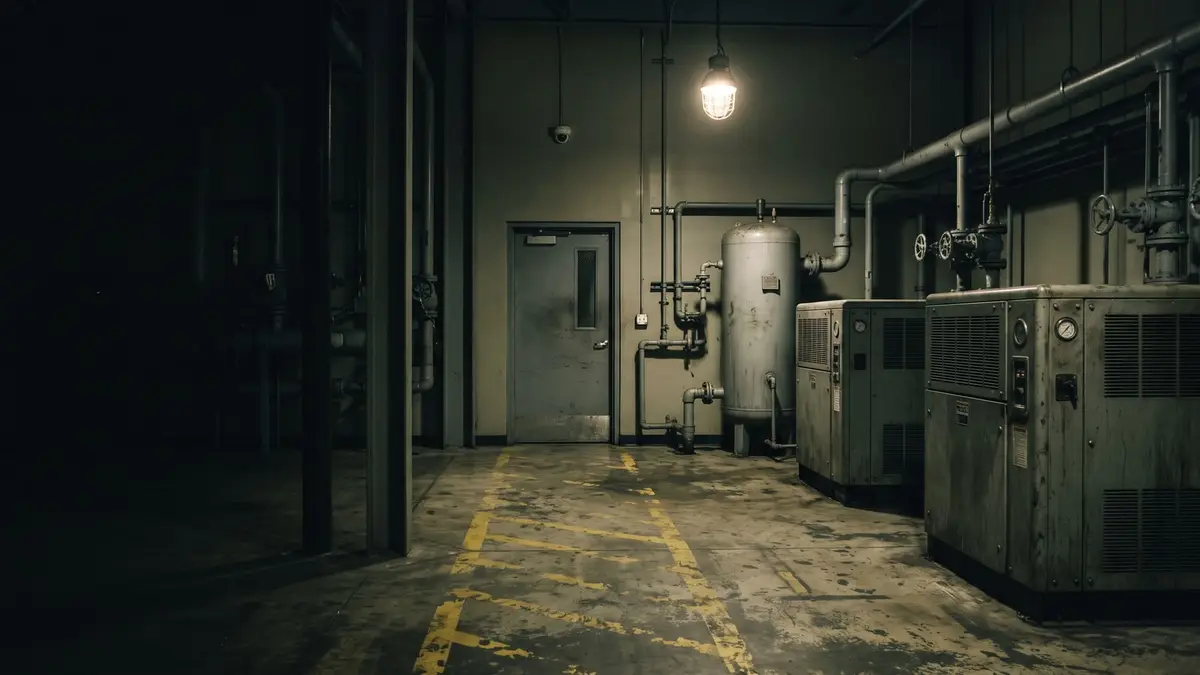
Person down detection exists for the minutes between a worker collapsing and anyone knowing. OSHA expects emergency care to be available within three to four minutes of a workplace where serious injuries are possible, but an emergency plan starts only when someone reports the emergency. For a technician alone in a compressor room on the night shift, that report waits for the next radio check: with an hourly check, half an hour on average and up to an hour.
Person down detection is an alert that fires when someone is on the floor and stays there. A worn device senses its wearer falling, or lying still too long. A camera rule sees a person lying motionless in its view. Either one shortens the time from a collapse to its discovery. Neither one shortens the time from discovery to care.
Person down detection times the interval your emergency plan doesn’t
Every unwitnessed collapse runs on two intervals: injury to discovery, then discovery to care. An emergency plan is built for the second. The first is whatever the site’s routine happens to make it.
Where an OSHA standard requires an emergency action plan, 29 CFR 1910.38 lists what it must contain, and the first item is procedures for reporting a fire or other emergency. Evacuation, rescue and medical duties, and the head count all follow the report. That order works for a fire, which announces itself with smoke and an alarm. A worker who collapses alone announces nothing.
OSHA’s first-aid reading is about distance, how quickly care can reach someone at the workplace, but its reason is the minutes after an injury, and those run whether or not anyone knows. The plan starts only when someone finds the person.
Why OSHA’s first-aid window is three to four minutes, not fifteen
The standard, 29 CFR 1910.151(b), sets no number. Where no infirmary, clinic or hospital is in near proximity to the workplace, it requires a person or persons adequately trained to render first aid, and adequate first-aid supplies readily available.
OSHA’s interpretation letters supply the number. The current reading comes from two 2007 letters, restated in OSHA’s 2019 letter on first aid for bleeding control. Where serious accidents such as falls, suffocation, electrocution or amputation are possible, emergency care must be available within three to four minutes. Where serious injury is more remote, as in an office, up to 15 minutes may be reasonable. A plant with compressors, boilers, conveyors and powered equipment is the first kind of workplace. The 2019 letter adds that “these time limits are maximums,” and that a response under three minutes would likely take trained first-aid employees on site.
The letters’ reason is physiological. For stopped breathing, cardiac arrest or uncontrolled bleeding, first aid has to come within the first few minutes to avoid permanent impairment or death. According to the Institute of Medicine’s 2015 report on cardiac arrest, the likelihood of survival falls by 10 percent with every minute between collapse and the heart beating again on its own.
OSHA’s letters from 1992 and 1994, now archived and marked as possibly out of date, put the clock in plain words: three to four minutes “from time of injury to time of administering first aid.” The old wording put the minutes before anyone knows inside the window. Neither version says how the worker gets found.
This article describes OSHA’s rules and letters. It isn’t medical or legal advice, and planning first aid and emergency response stays the employer’s duty under the standard.
Where a collapsed worker goes unfound in a plant at night
NIOSH defines lone work as a condition where someone can’t be seen or heard by another worker and help isn’t readily available. In a plant after 10 p.m., that describes three kinds of place:
- Plant rooms. The compressor room, the boiler room, the pump house. Closed doors, constant noise, and nobody passes through on the way to anywhere.
- The maintenance round. A technician walking between buildings, alone by design, reading gauges and logging them.
- The single post. One operator on a line that runs all night, with the nearest colleague at the far end of the building.
NIOSH also says the United States has no comprehensive legal standard on working alone. OSHA prohibits lone work only in specific high-hazard cases, such as entry into a permit-required confined space, where 29 CFR 1910.146 keeps an attendant outside for the whole entry. A compressor room isn’t a permit space, and no rule puts a second person at its door.
OSHA’s one rule written for working alone, 29 CFR 1915.84, covers shipyard employment. When a shipyard worker works alone, in a confined space or an isolated location for example, the employer must account for them at regular intervals by sight or verbal communication. It doesn’t apply to a factory. A plant can still borrow its test, because it asks the right question of every lone post: when did someone last see or hear this person?
The public data can’t say how often that question goes unanswered. NIOSH notes that most occupational health information systems don’t systematically record whether a worker was alone when something happened. The Bureau of Labor Statistics’ fatality census excludes illness-related deaths unless an injury event set them off, so a night-shift worker who dies of a heart attack isn’t counted unless an injury contributed. A plant has to work out its own exposure, room by room.
A check-in schedule can’t find anyone inside four minutes
Consider a hypothetical plant. One maintenance technician covers the night shift, 10 p.m. to 6 a.m. The round takes in an air compressor room, a boiler room and a wastewater pump house at the far end of the site. The line supervisor raises the technician on the radio every hour.
If the technician collapses at a random moment, the next radio check is on average 30 minutes away, and up to 60. A missed call from a compressor room running at full load may just be a radio nobody heard, so the supervisor tries again. Then they walk, and if the pump house is the third room they try, call it ten more minutes before anyone kneels beside the technician. The plan’s clock starts there, on average about 40 minutes after the collapse.
The arithmetic holds for any schedule. With a check every N minutes, the missed check comes on average N/2 minutes after a collapse, and at worst N, before anyone has started looking.
| Check-in every | Average time from collapse to the missed check | Longest |
|---|---|---|
| 2 hours (a walking round) | 60 minutes | 120 minutes |
| 1 hour | 30 minutes | 60 minutes |
| 30 minutes | 15 minutes | 30 minutes |
| 15 minutes | 7½ minutes | 15 minutes |
| 4 minutes | 2 minutes | 4 minutes |
Read the last row. Even if you counted OSHA’s three to four minutes from the collapse, as its archived letters did, only a radio answered every four minutes all night would fit, and the search would still come after. A check-in schedule puts a ceiling on how late you find out. It can’t make finding out fast.
NIOSH’s bulletin describes a real case. An Oregon nursery worker didn’t return to the van for the 3 p.m. break, and calls went to the phone he had left in it. His coworkers found him unconscious where he had been working, the emergency response took about 10 minutes more to arrive, and he died of heat stroke and dehydration. The check-in did its job: it started a search.
Check-ins, wearables and cameras: what raises each alarm and what each misses
Fast discovery takes something that alarms on its own.
| Option | What raises the alarm | Who it covers | What it misses |
|---|---|---|---|
| Scheduled check-in | A missed call or a missed log entry | The worker carrying the radio, anywhere | Everything between checks |
| Worn man-down device | A fall or a stretch without movement, or a press for help | Whoever is wearing it, wherever they go | Anyone not wearing it: a device left on the charger or with a dead battery, a contractor, a visitor |
| Camera person-down detection | A person lying motionless in the camera’s view | Everyone in the covered room, with nothing to wear or press | Rooms without a camera, and floor the camera can’t see |
| A second person | Sight or sound | The pair | Little while the two stay together. It costs a second wage |
A wearable’s hidden cost is supervision: someone has to see that it’s charged and worn, every shift.
Choose by place:
- A room someone passes through for a few minutes: the check-in schedule is enough.
- A room where one person works for long stretches, with a camera that sees the floor: camera detection.
- A route that crosses rooms and yards no camera covers: a wearable.
- Inside a vessel or a permit space: the attendant 1910.146 already requires.
How camera person-down detection fails, and how to tell where it will
A camera rule for person down asks two things of the scene: is a person lying on the floor, and have they stayed there? The second question keeps it from firing on someone who drops to the floor for a moment to look under a skid. It’s also a trade. The longer the rule waits, the fewer false alarms, and the later the alert.
Most failures come from the room itself:
- There’s no camera. If your cameras were placed for theft and traffic, they watch docks, gates and aisles. The plant rooms where people work alone at night may have none.
- The floor is out of view. A technician who goes down behind a compressor skid, between a boiler and the wall, or inside a tank isn’t in the image. A camera aimed at a door sees the door.
- The room goes dark. Plant rooms on occupancy-sensor lighting switch off when nobody moves, which is exactly what a collapsed worker does. A camera with infrared falls back to it, and video analytics sees a different image at night. One without sees a dark room.
- Someone lies down on purpose. A mechanic on a creeper under a conveyor looks a lot like a person down. Expect those alerts, and decide in advance who confirms them.
- The collapse doesn’t end on the floor. A worker who slumps over a desk or against a railing isn’t lying down. Ask any vendor what their rule does with a seated collapse.
- The camera moved or died. A dome nudged during maintenance watches a wall, and a camera that has stopped streaming watches nothing. Both look like a quiet room unless something alerts on them.
To find your plant’s gaps:
- List every place one person works out of sight and earshot of others, shift by shift. Use NIOSH’s test: could anyone see or hear them?
- Write down how a collapse there would be found today, and the longest it could take: the check-in interval, the round, the shift change.
- Stand where the work happens and look at the camera’s image, if there is a camera. Check how much of that floor it shows, and what it shows with the lights off.
- Assign each place a method: a camera rule, a wearable, a shorter check-in or a second person.
- Time a drill from a simulated collapse to a trained responder standing in the room. That number covers both intervals.
A camera in a plant room also watches employees, and NIOSH cautions that lone-worker monitoring can add stress of its own. Check employee monitoring laws by state and what they require for cameras before it goes up, and tell the crew what it’s for.
Running person-down detection on plant-room cameras
Nsightify’s Physical Safety includes person down, ready to run. It alerts when someone has collapsed or is lying motionless in a monitored area, and the alert reaches the supervisor through the channels the team already uses. Nobody has to press, wear or check in with anything. It runs on existing cameras that hand a live stream to other software. A camera with no stream at all is out of scope today, and a camera that streams only on the local network connects through Nsightify Edge Relay.
Any detection can be restricted to a shift, a night window or a weekend, and the customer chooses whether evidence is still captured outside the window. Camera tampering flags a dome that has been obstructed, defocused or repositioned, and a separate alert fires when a camera’s stream drops, so a dead camera doesn’t pass for an empty room. The same platform watches restricted zones on the production floor, as in where optical zone detection fits around machine guarding.
Person-down detection shortens the interval from collapse to discovery in the rooms the cameras see. Rooms without a camera still need a wearable, a check-in or a second person. The walk to the room, the first-aid training and the plan stay with the site. Bring a seated, slumped collapse to the demo as a test case. An alert also needs someone awake to read it, the problem behind how many cameras one person can monitor.
Frequently asked questions
How long does OSHA give you to respond to an injury?
The first-aid standard, 29 CFR 1910.151(b), names no number. OSHA’s interpretation letters do. Where serious accidents such as falls, suffocation, electrocution or amputation are possible, emergency care must be available within 3–4 minutes of the workplace. That measures how far away care is, rather than setting a deadline from the injury. Where serious injury is less likely, as in an office, up to 15 minutes may be reasonable.
Does OSHA require a first aid responder on site?
When no infirmary, clinic or hospital is in near proximity to the workplace, 29 CFR 1910.151(b) requires a person or persons adequately trained to render first aid, and adequate first-aid supplies readily available. OSHA reads near proximity as 3–4 minutes where serious injuries are possible, and its 2019 letter says a response under three minutes would likely require trained first-aid employees on site.
Is there an OSHA standard for working alone?
Not for general industry. NIOSH says the United States has no comprehensive legal standard on working alone, and OSHA prohibits lone work only in specific high-hazard cases, such as entry into a permit-required confined space, where an attendant stays outside. OSHA’s one rule written for working alone, 29 CFR 1915.84, covers shipyard employment: workers alone must be accounted for at regular intervals by sight or verbal communication.
How does person down detection work?
It raises an alert when someone goes down and stays down. A worn device senses its wearer falling or lying still too long, or the wearer presses for help. A camera-based rule watches an area and alerts when a person is lying motionless in view. The worn device covers one person wherever they go. The camera covers everyone in the room it sees.
List the lone posts, time the drill, and then book a demo of person-down detection on a plant-room camera you already own.
More on this from Nsightify: PPE detection and hazard-zone monitoring.

See Nsightify in Action
We're onboarding a limited number of pilot partners. If you're an operations or security leader in construction, warehousing, or manufacturing — let's talk.