Video Analytics at Night Sees a Different Image
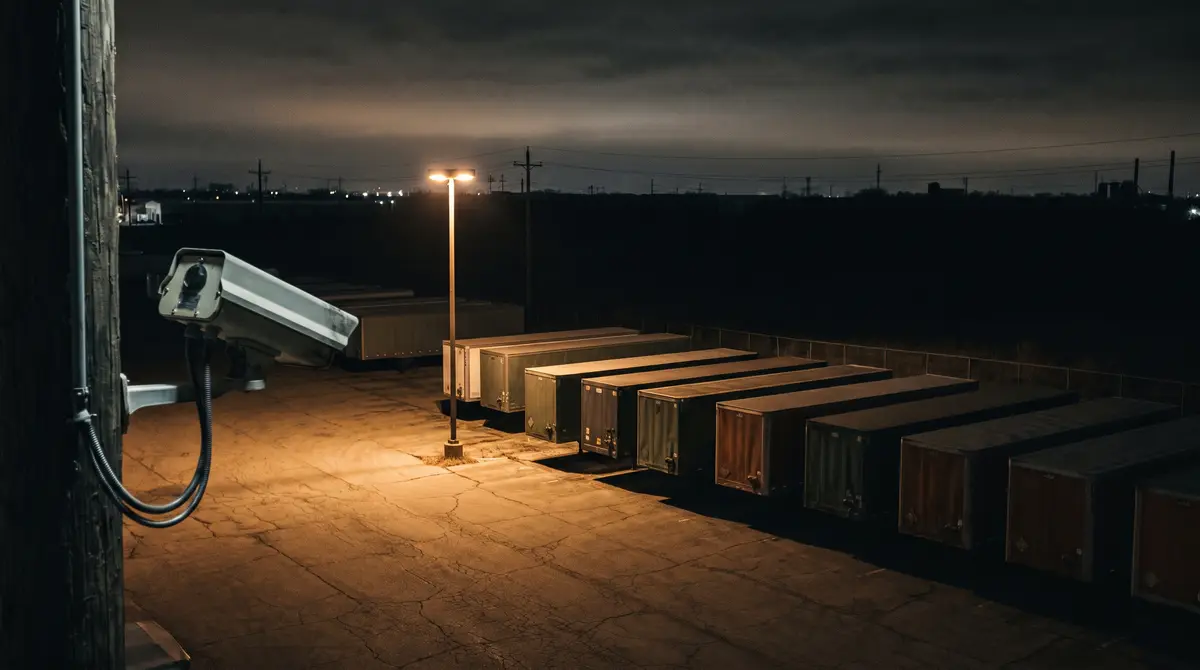
Perimeter analytics is bought for the hours nobody is on site and usually demonstrated in daylight. Video analytics at night works on a different picture: lit by the camera’s own infrared or by whatever site lighting is left, uneven across the frame, and useful over a shorter distance than the daytime view. The clocks go back on November 1, and that picture arrives an hour earlier on the evening shift.
What changes when a camera switches to night mode
When the light drops below what the sensor needs for a usable frame rate, a day-and-night camera removes its infrared-cut filter, switches to grayscale and, if it has one, turns on its infrared illuminator. Color is gone because infrared leaks through all three of the sensor’s color filters. Axis Communications, in its July 2026 white paper on infrared in surveillance, notes a side effect: some materials take unexpected shades of gray, so a dark jacket can look light.
Grayscale on its own is not the problem. The same paper calls well-lit infrared video particularly suitable for analytics. What changes is everything around the color:
| Daytime view | Night view | |
|---|---|---|
| Light source | Daylight across the whole frame | The camera’s own infrared, or the site lighting still on |
| Evenness | Shadows, but light everywhere | Bright near the light, dark at the edges |
| Usable distance | The field of view | As far as the light reaches |
| Focus | Set for visible light | Can shift under near-infrared |
| Noise and blur | Low at short exposures | Higher, because low light needs longer exposures or more gain |
| Color cues | Available | Gone |
Every row on the right is a reason a detection that works at noon can miss at 2 a.m.
A detector trained in daylight missed most pedestrians at night
Pedestrian-detection research has measured this gap directly. In the NightOwls study, presented at the Asian Conference on Computer Vision in 2018, a leading detector trained on daytime street images missed 7.36% of pedestrians on daytime data and 63.99% on night images from a vehicle camera. Trained on night images instead, the same detector missed 17.80%. Training accounts for most of that gap. The rest is the dark.
Surveillance footage is harder than a windshield camera’s view. The NightSurveillance benchmark, published at IJCAI 2020, was built from 20 surveillance cameras recording from 5 p.m. to 5 a.m. Trained and tested on that footage, the best detector its authors compared still missed 21.73% of pedestrians. The hard cases were the ones a perimeter cares about:
- Small, distant pedestrians: the best result missed 38.96%.
- Rain: 32.61%.
- Blurred frames: 43.23%.
Brightness was not the cure. Misses were lowest for pedestrians of medium brightness, so overexposure near a light hurt as well as darkness at the edge. The small, far pedestrian is also where pixels run out first, which is the arithmetic in how to calculate pixels per foot for video analytics.
These are research detectors on public benchmarks, not any vendor’s product figures. Two conclusions still carry over. A daytime result doesn’t predict a night result, and in NightOwls the gap narrowed most once the detector learned from night images. So night performance has to be measured on its own, on night footage.
Check a lit scene the way the Defense Department does
Where a scene is lit by site lighting (pole lights, wall packs, dock lights), there is a published way to check it before anyone runs a pilot. UFC 4-021-02, the Defense Department’s design criteria for electronic security systems, in its edition dated July 28, 2025, has video designers verify that each scene of interest has enough light and specify lighting upgrades where it doesn’t.
Faceplate illuminance is the light that actually reaches a camera’s sensor after the scene’s surfaces and the lens have each taken a share. UFC 4-021-02 computes it from the scene’s illuminance, the scene’s reflectivity, and the lens’s transmittance and f-number, then compares the result with the minimum the camera needs at its faceplate.
The equation is short:
Faceplate illuminance = scene illuminance × reflectivity × lens transmittance ÷ (4 × f-number²)
- Scene illuminance comes from light-meter readings across the scene, in foot-candles.
- Reflectivity depends on the surface. The UFC’s table puts asphalt at 0.07, grass and trees at 0.2, Portland cement concrete at 0.4 and snow at 0.85.
- Lens transmittance is typically 0.8.
- Camera minimum and f-number come from the datasheet. Divide a lux figure by 10.76 to get foot-candles. The equation needs the light the camera requires at its faceplate, as in the UFC’s example; if the datasheet doesn’t say where its minimum was measured, ask the maker.
The UFC’s worked example is a camera that needs 0.0007 foot-candle at the faceplate, behind an f/1.6 lens, watching dark aircraft on asphalt under an average of 1.2 foot-candles. That delivers about 0.007 foot-candle at the faceplate, more than nine times what the camera needs.
Now point the same camera at a distribution center’s trailer yard, also asphalt. Turned around, the equation gives the lowest reading that still passes: camera minimum × 4 × f-number² ÷ (reflectivity × transmittance), about 0.13 foot-candle here. Say the meter averages 1.2 and reads 0.08 at the far row of trailers. The average passes. The far row puts about 0.0004 foot-candle on the faceplate, under the camera’s 0.0007.
The UFC also limits how uneven a scene can be. Design for an average-to-minimum ratio no greater than 4:1 within a scene of interest, it says, and video quality degrades noticeably past 8:1. At an average of 1.2 foot-candles, that asks for at least 0.3 at the darkest point, more than double what the camera alone requires. This yard runs at 15:1.
Two cautions keep the check honest. Never compare a minimum-illumination figure across makers, who measure it differently, as Axis notes in its Lightfinder white paper. And a light meter reads visible light, so this check covers scenes lit by site lighting. A scene lit by the camera’s own infrared needs the walk test described below.
Infrared range ends where the illuminator’s light runs out
When a camera lights the scene itself, range depends on the camera’s resolution and how far the illumination reaches, according to Axis. The beam is a trade-off. Too narrow, and it whites out the middle of the scene and leaves the edges dark. Too wide, and it loses reach straight ahead.
The UFC gives a sense of scale. It puts a 26-watt LED illuminator’s coverage at about 65 feet with a 120-degree flood and about 310 feet with a 10-degree spot. A wide-angle camera covering a whole yard may light only the first stretch of it at night.
The field of view is the daytime promise. The beam is the night one.
- Field of view, 120° The yard the camera covers by day
- Infrared flood, 120° Lights about 65 ft
- Infrared spot, 10° Lights about 310 ft down a narrow line
- Site light Check it with a light meter
Infrared also bounces. Light reflecting off a nearby wall, eave or ceiling can flood the image, and dirt, spider webs, water droplets or snow on a dome reflect it straight back into the lens, according to Axis. Insects are drawn to the light, so an illuminator mounted at the lens draws them into the frame. And the lens may not focus both kinds of light alike: Axis notes that conventional lenses often shift focus between visible and near-infrared light. A camera focused at noon can be soft at 2 a.m.
Site lighting is designed for work, and the work stops at night
Most site lighting exists so people can work, and it is switched and scheduled around them. The UFC notes that after-hours lighting inside buildings may be significantly lower than operating lighting. A yard’s pole lights may run on a timer or photocell schedule set for shift operations, and the overnight yard is where a loaded trailer can sit unwatched, one exposure behind cargo theft statistics for 2026. The light check has to run at the hour a detection matters, with the lights as they actually run.
On construction sites the federal rule says it outright. 29 CFR 1926.56 sets minimum illumination (5 foot-candles for general construction area lighting, 3 for excavation, accessways and active storage, 10 in construction plants and shops) only while any work is in progress. Nothing in the rule requires light once work stops, which is when a jobsite camera is on duty.
Current as of October 5, 2026: OSHA proposed rescinding 1926.56 and the related 1926.26 on July 1, 2025, and has not issued a final rule.
How to tell whether a night zone needs light, a move or a new camera
The night walk shows which failure a zone has, and each failure has a different first fix.
| What the night walk shows | Likely cause | First fix |
|---|---|---|
| Misses at the far edge only | The light runs out | Light the far edge, or pull the zone in |
| White-out near a pole light | Glare in the frame | Move the fixture out of the view and above the camera |
| A soft image only at night | Focus shift under infrared | Check and refocus on the night image |
| Flare, or insects crossing the lens | Illuminator mounted at the lens | Mount a separate illuminator away from the camera |
| Misses on a scene a person can read | The detector | Measure it on your own night footage |
| Unreadable even when lit | The camera | A faster lens, or a different camera |
The glare fix is the UFC’s: keep fixtures out of the camera’s view, and above it. A faster lens is the equation working in your favor, because going from f/1.6 to f/1.2 puts about 1.8 times as much light on the sensor. The most different camera is a thermal one. It senses heat, works in complete darkness and is less affected by rain and fog, according to the UFC, which also lists its high cost and its inability to show facial features or fine detail.
When the check fails at a single far corner, the cheapest fix is often a light aimed at that corner.
Testing video analytics at night before a pilot signs off
A night acceptance test belongs in the pilot criteria before the pilot starts. It follows the same logic as testing video analytics on your own cameras, run after dark.
- Choose the hardest camera for each zone that matters: the far edge, the light pole in the frame, the corner past the beam.
- Run the light check on lit scenes at the hour the detection matters, with the lights as they actually run.
- Walk the zone after dark. Walk the far edge, cross the zone, and stand in the brightest and darkest spots. Record what the system flags each time, and check focus on the night image.
- Repeat in the weather you get: rain, fog and the first frost.
- Count false alerts per camera per night, separately from the day: insects, headlights sweeping a fence, infrared bouncing off a nearby wall, rain or spider webs on the dome.
- Write the night pass mark down before the first walk, so the result decides the pilot instead of the other way around.
Running perimeter detections in the night window
Nsightify works with existing IP and CCTV cameras, so the night check decides which of them can carry an after-hours detection. The detections that matter in these hours are ready to run: after-hours zone entry and intrusion into a restricted zone, loitering and stopped vehicle. Detection scheduling restricts any detection to a night window, and the customer chooses whether evidence is still captured outside it. Fence-climbing and perimeter pacing are included and switched on at commissioning, once tuned against the site’s own footage.
Camera tampering alerts when a camera is moved or its view is blocked, and a separate alert fires when a stream drops. None of it changes the physics. Analytics works with the image the camera produces, and a zone a person can’t make out on a monitor at 2 a.m. is a zone to relight or re-aim before anyone automates it.
Frequently asked questions
Do security cameras work at night?
Most do, by switching to night mode. The camera removes its infrared-cut filter, records in grayscale and, if it has an illuminator, lights the scene with infrared. The image is usable, but it is lit unevenly and reaches only as far as the light does. Whether analytics works on it depends on the light at the far edge of each zone, and only a test after dark shows that.
How far can a security camera see at night?
As far as its light reaches, which is usually less than its daytime field of view. With infrared, range depends on the camera’s resolution and the illuminator’s beam. The Defense Department’s design criteria cite a 26-watt LED illuminator covering about 65 feet with a 120-degree flood and about 310 feet with a 10-degree spot. With site lighting, the darkest point of the zone sets the limit. Measure your own rather than trusting a datasheet range.
Why does my camera keep missing people at night?
Common causes: the far edge of the zone gets too little light, a light or reflection washes out the image, the lens is focused for daylight, the person is too small in the frame, or the detector learned mostly from daytime images. In the 2018 NightOwls study, a detector trained on daytime street images missed 7.36% of pedestrians by day and 63.99% on night images from a vehicle camera. Trained on night images, it missed 17.80%.
Do I need lights if I have infrared cameras?
Often, yes. Infrared lets a camera see without visible light, at the cost of color and range, and a nearby wall, rain or a spider web on the dome can bounce the light back into the lens. Visible lighting extends usable range and lets you check the scene with a light meter. Where infrared fails a walk test, a light aimed at the far edge is often the cheapest fix.
Walk your darkest zone after dark, then book a perimeter security demo before the clocks go back on November 1.
More on this from Nsightify: AI video analytics on existing IP and CCTV cameras.

See Nsightify in Action
We're onboarding a limited number of pilot partners. If you're an operations or security leader in construction, warehousing, or manufacturing — let's talk.