Cargo Theft Statistics 2026 Show Fewer, Bigger Thefts
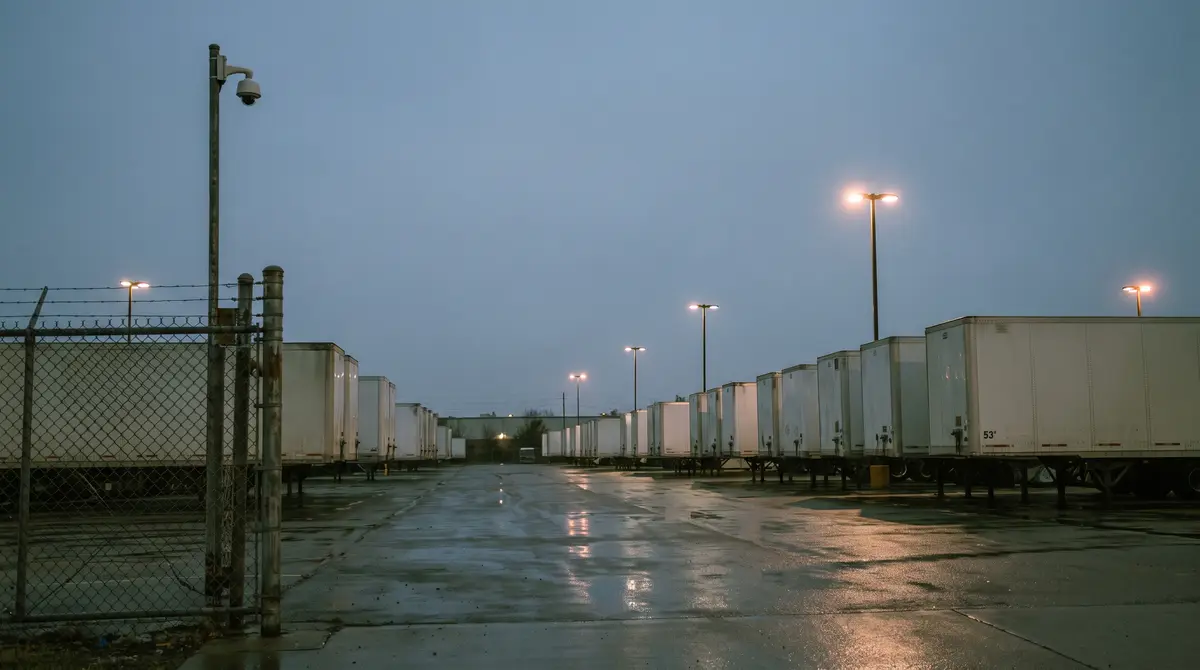
Read the cargo theft statistics for 2026 in the wrong order and they look like good news. Verisk CargoNet recorded 26% fewer thefts across the United States and Canada in the second quarter than a year earlier, and estimated losses more than doubled, to $304.6 million. For any site that holds loaded trailers, the question stops being how often thieves come and becomes what is sitting unattended on the night they do.
Cargo theft statistics for 2026 point two ways at once
The headline numbers come from Verisk CargoNet’s second-quarter release, published on 6 August. CargoNet recorded 677 theft incidents in the quarter, down 26% from the second quarter of 2025 and 14% from the first quarter of 2026. Estimated losses reached $304.6 million, against $135.7 million a year earlier.
Fewer events and larger losses can only mean one thing: on average, each theft is taking more. CargoNet put the average value, among thefts with a reported commodity value, at $564,009. Then it added a caveat: the figure was “heavily influenced by a small number of extreme, multimillion-dollar losses.”
That caveat is the story. An average pulled up by a handful of enormous events does not describe a typical theft. It describes a distribution with a long tail, where most incidents are ordinary and a few are catastrophic. The losses are concentrated, not evenly larger.
The longer trend runs the same way. CargoNet estimated 2025 losses at $725 million, up 60% on 2024, with confirmed cargo thefts up 18% and an average value per theft of $273,990. Summarizing 2025, CargoNet’s vice president of operations described organized groups as “targeting extremely high value shipments rather than relying on opportunistic theft.”
Cargo theft, as the FBI’s Uniform Crime Reporting Program defines it, is the criminal taking of goods that make up a commercial shipment of freight moving in commerce, from, among other places, a truck, trailer, container, warehouse or distribution facility. The definition treats cargo as moving at every point between origin and destination, including any temporary stop along the way.
That last clause is the one that matters for a site. Under the FBI’s cargo theft definition, a loaded trailer parked in a drop lot overnight is still freight in transit. The yard is part of the route.
Why incident counts mislead a yard security budget
Site security budgets are usually argued from frequency. How many incidents did we have last year? How many did the region have? Is the trend up or down? That logic worked when losses were many and small, because the incident count tracked the cost. It stops working once a few events carry most of the loss.
The count invites deferral. A falling incident rate reads as a reason to wait a year. The same quarter that produced 26% fewer thefts produced more than double the losses. A security lead who reports only the first number to finance is reporting good news that is not true.
The average invites the wrong budget. Divide a loss total by an incident count and you get a figure that describes no actual event. Plan around $564,009 per theft and you overestimate most incidents and badly underestimate the one that matters.
One control is asked to stop three different crimes. A fence, a camera and a guard address a thief who physically takes a trailer. They do nothing about a thief who arrives with convincing paperwork and is handed the load at the dock. They do nothing about one who redirects a shipment by compromising a carrier’s email. Treating cargo theft as one problem means buying one kind of answer and assuming it covers the rest.
Plan yard security around the high-value load
The practical shift is small to describe and harder to do. Stop asking how often theft happens and start asking which loads on your site would be a disaster to lose, where they sit, and for how long.
Split the count into the crimes it contains
CargoNet’s release separates the categories, and they are moving differently. The split decides which controls are even relevant.
| Crime | What changed in Q2 2026 | What actually reaches it |
|---|---|---|
| Events CargoNet classifies as theft | 378 events, down from 488; CargoNet saw fewer organized thefts of unattended trailers | Locks, yard layout, after-hours detection and a response plan |
| Fictitious pickup: a thief poses as the carrier | 158 events, against 165 a year earlier | Carrier and broker vetting, driver identity checks, secure pickup numbers |
| Email compromise and shipment misdirection | Persistent, per CargoNet; comparatively stable in California and Texas; no count published | Cybersecurity and payment and dispatch verification |
Two readings follow. Events CargoNet classifies as theft are falling but are still the largest category, 378 of 677. Fictitious pickups barely moved, and CargoNet calls account compromise and misdirection persistent. Part of the fall came from fewer non-delivery schemes, which no camera sees either. Any honest yard security plan has to carry both facts at once.
Price the tail, not the average
If the loss is concentrated in a few events, the planning unit is the high-value load, not the typical incident. CargoNet’s commodity data shows where thieves are aiming. Metal thefts rose from 54 in the second quarter of 2025 to 80 in the second quarter of 2026, with copper the most targeted. Enterprise technology continued to draw organized groups. Beverages and grocery fell by 36 events combined; seafood rose by 11.
The exercise for a site is short. List the loads that pass through in a typical week and mark the handful whose loss would be a board-level event, not an insurance claim. Then note how long each one sits in the yard between arrival and departure. The tail risk lives in that short list, and it moves week to week with what you are holding.
The unit of exposure is not the incident. It is the loaded trailer nobody is watching.
Treat the unattended loaded trailer as the thing to protect
Travelers’ guidance on cargo theft tactics starts in the same place: avoid unattended loaded trailers where possible, especially in high-theft areas. The insurer also recommends high-security rear door locks and air cuff locks, and landing gear locks where staging or dropping a load cannot be avoided. Each one turns a quick hitch-and-drive into something that takes time and tools.
Those controls delay a theft. They do not tell anyone it is happening. A lock that holds for several minutes is only worth those minutes if someone learns within them that a vehicle is backed up to the trailer. Delay and detection work as a pair, and a yard that has one without the other has bought half a control.
Watch the calendar, including the days you are open
CargoNet’s Labor Day analysis, published on 4 September, covered five years, 2021 to 2025. It counted each holiday window from the Thursday before Labor Day to the Wednesday after. Across 273 thefts, the four weekdays in that window accounted for 194, or 71%. Saturday through Monday accounted for 79.
Per day, that is an average of about 48.5 thefts per weekday against about 26 per weekend day, over the five years combined. The busiest days were not the ones when the yard was emptiest. The annual count also climbed, from 33 in 2021 to 56 in 2025, with a peak of 70 in 2024. California, Texas and Illinois together accounted for 130 of the 273.
CargoNet’s own reading is that the weekday pattern fits the growing share of theft carried out through deceptive pickups and non-delivery schemes, which need working offices and phone lines to succeed. It also names the physical exposure of freight left sitting while sites are closed. So two questions are worth asking about your own site: who confirms carriers and pickups on the days around a holiday, and which loads are staged before a long weekend and collected after it? Thanksgiving falls on 26 November this year, and the same question applies to the whole year-end period.
Three yard conditions worth an after-hours alert
A yard does not need to watch everything. It needs to know quickly about the few conditions that precede a physical theft. For an importer in CBP’s CTPAT program, the container yard is also one of the sensitive areas where CTPAT’s camera requirements recommend alarms on unauthorized entry.
- A vehicle stopped where nothing should stop. Along the fence line, at a closed gate, beside the drop lot, outside operating hours.
- A person inside the yard boundary after hours, or lingering along the fence where the loaded trailers are parked.
- Something leaving that was supposed to stay. Goods or equipment removed from where they were staged, or a vehicle heading out through the gate outside operating hours.
Each of these is a visual fact in a scene. Each one is also useless as an alert unless it reaches a person who can act, which is why calibrating loitering detection to cut false alarms matters as much as detecting anything at all. An operator who clears false alerts all night learns to treat every one as nothing, the pattern known as alert fatigue in perimeter security.
What after-hours yard detection can and cannot do
Nsightify runs on the yard’s existing IP and CCTV cameras. The detections that map to the conditions above are part of perimeter security monitoring on existing cameras: after-hours zone entry, loitering, stopped vehicle, restricted-area dwell, directional tripwire crossing, and person and vehicle classification, all active from day one. Removed object and perimeter pacing are included and switched on at commissioning, once they are tuned against the site’s own footage.
Each alert reaches the people responsible in real time, which is the half of the delay-and-detection pair that locks cannot provide.
The limits are specific. Nsightify does nothing about fictitious pickups: it does not check a driver’s paperwork, read a bill of lading or confirm a pickup number. It does nothing about email compromise or shipment misdirection. On the physical side, detection depends on camera placement, lighting and weather, and lighting that is adequate for people crossing the yard is not always adequate for detection at the far fence. Detection is also not prevention. An alert buys time only if someone acts on it. The way to find out what your own cameras can do after dark is to test the analytics on your own cameras before relying on them. Whether the light reaches the far fence can be checked before that test, and video analytics at night shows how.
Frequently asked questions
Is cargo theft going up or down?
Both, depending on the number. Verisk CargoNet recorded 677 theft incidents in the United States and Canada in the second quarter of 2026, 26% fewer than a year earlier. Estimated losses for the same quarter were $304.6 million, against $135.7 million in the second quarter of 2025. For 2025 as a whole, CargoNet estimated losses of $725 million, up 60% on 2024.
What is a fictitious pickup?
A fictitious pickup is a theft in which someone poses as a legitimate carrier and is handed the load. Nothing is broken into. Verisk CargoNet counted 158 fictitious pickups in the second quarter of 2026, against 165 a year earlier. Travelers recommends vetting carriers and brokers and, at pickup, confirming driver identity, truck and trailer details and a secure pickup number.
When does cargo theft happen around holidays?
Often on the working days around the holiday, not the holiday itself. Verisk CargoNet analyzed Labor Day windows from 2021 to 2025, counting from the Thursday before to the Wednesday after. The four weekdays in that window accounted for 194 of 273 thefts, or 71%. Saturday through Monday accounted for 79. CargoNet links the pattern to deceptive pickup and non-delivery schemes, which depend on working offices.
Where does most cargo theft happen?
The 2026 releases from Verisk CargoNet do not publish a breakdown by location type. Its Labor Day analysis describes theft clustering around dense freight networks, large consumer markets, intermodal infrastructure and places where stolen goods can be resold quickly. Percentages circulating online that assign a share of theft to warehouses or parking lots could not be traced to a dated primary source.
How do you secure a truck yard at night?
Start by reducing what is exposed. Travelers recommends avoiding unattended loaded trailers where possible, fitting high-security rear door locks and air cuff locks, and adding landing gear locks when staging loads is unavoidable. Then make sure someone learns quickly when a vehicle or person is in the yard after hours, and has a plan to respond before the load is gone.
What to check before Thanksgiving
Pull last quarter’s inbound and outbound schedule and mark every high-value load that sat in the yard overnight, and for how long. Then check the cameras covering those spots after dark, not at noon. Most sites can do that with the cameras already on the poles, which is the point of adding AI video analytics to cameras you already own rather than starting over. Whatever that night check leaves unanswered, ask the Nsightify team about your yard.
More on this from Nsightify: AI video analytics on existing IP and CCTV cameras.


See Nsightify in Action
We're onboarding a limited number of pilot partners. If you're an operations or security leader in construction, warehousing, or manufacturing — let's talk.