California Workplace Surveillance Laws: Where Cameras Cannot Go
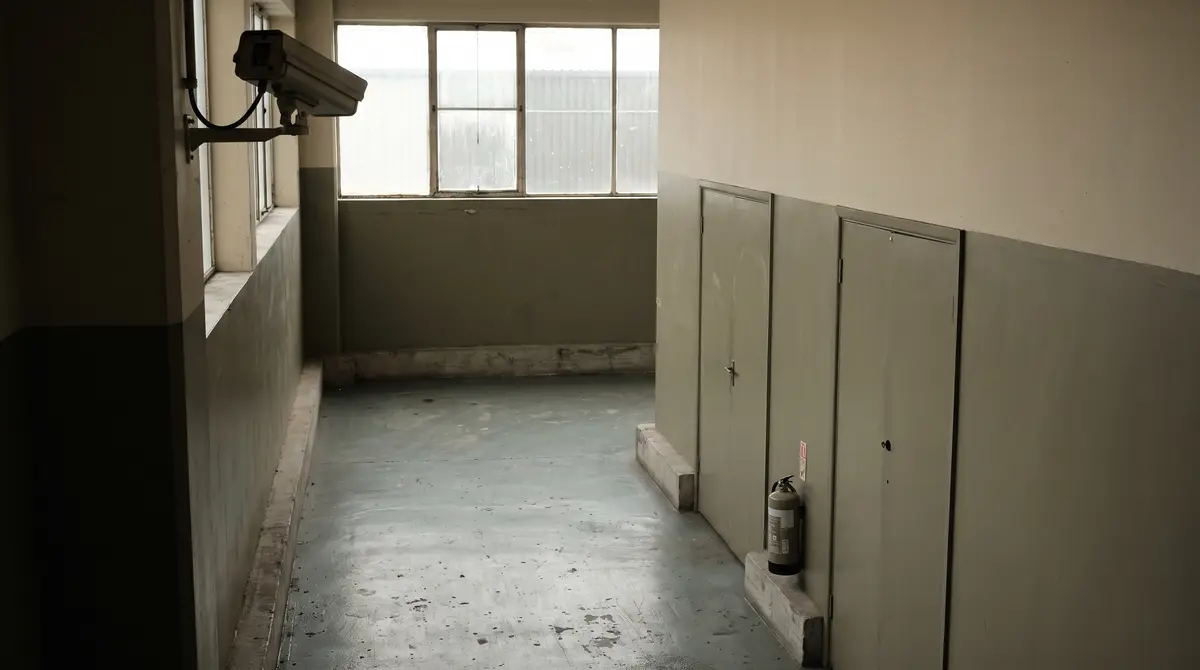
A camera map is drawn by whoever mounted the cameras, usually years ago, for reasons nobody wrote down. California workplace surveillance laws name three rooms where a recording of an employee is prohibited outright — and a law signed on 30 September 2026 puts a per-violation penalty, from 1 January 2027, behind a narrower version of the same rule. Placement stops being a facilities decision at that point and becomes something a site has to be able to defend.
What California workplace surveillance laws already prohibit
Whatever the new law below adds, the operative rule has been on the books since 1 January 1999 and is short enough to read in full.
Labor Code section 435 prohibits an employer from causing an audio or video recording to be made of an employee in a restroom, a locker room, or a room designated by the employer for changing clothes, unless a court order authorizes it. Subdivision (b) adds a second, separate prohibition that is routinely missed: a recording made in violation of the section may not be used by the employer for any purpose. It applies to private and public employers alike, excepting the federal government. A violation is an infraction.
Two things in that paragraph do more work than they appear to.
It names rooms, not expectations. Most writing on workplace privacy reasons from a reasonable expectation of privacy, which is a standard applied after a dispute exists. Section 435 does not ask a site to predict how a court would weigh anything. It names three rooms.
The bar on use is independent of the bar on recording. If footage of one of those rooms exists — because a camera was aimed badly, because a changing area was designated after the camera went in, because a door was propped open — the employer cannot use it. Not in an investigation, not in a termination, not as evidence of theft. The recording being useful does not make it usable.
AB 1331 is now law: bathroom monitoring is banned from 2027
AB 1331, authored by Assemblymember Elhawary, adds a new part to the Labor Code — Part 5.8, commencing with section 1560 — governing workplace surveillance tools.
The bill’s history shows a bill that nearly died and then moved quickly. It went to the Senate inactive file on 13 September 2025 and sat there for eleven months. It was pulled off that file on 21 August 2026, amended on 21 and 28 August, and on 31 August — the last day either house could pass bills — the Senate passed it 28 to 5 and the Assembly concurred in the Senate amendments 61 to 7. Its enrolled text is dated 4 September 2026, and it was presented to the Governor on 14 September.
Article IV, section 10(b) of the California Constitution gave the Governor until 30 September to act on it. He signed it on 30 September 2026, and it was chaptered the same day as Chapter 851, Statutes of 2026.
It has no urgency clause and no operative date of its own, so article IV, section 8(c) sets the effective date: a statute passed at a regular session takes effect on the January 1 following a 90-day period from enactment, which puts it at 1 January 2027.
Current as of 1 October 2026. AB 1331 was signed on 30 September 2026 (Chapter 851, Statutes of 2026) and takes effect on 1 January 2027. Nothing below is legal advice.
What AB 1331 adds that Labor Code 435 does not reach
A workplace surveillance tool, under new Labor Code section 1560(f), is a system, application, instrument or device that collects, or facilitates the collection of, employee data, activities, communications, actions, biometrics or behaviors by means other than direct observation by a person. Smoke and carbon monoxide detectors are excluded, and so are weapon detection systems that automatically screen a person’s body. A fixed camera running analytics is squarely inside that definition. California’s emotion AI law, AB 1883, signed the same day, defines the term in nearly the same words and bars two uses of a tool that runs artificial intelligence: inferring a worker’s emotional state and collecting neural data.
The two instruments are easy to conflate and do different work.
| Labor Code 435 (law since 1999) | AB 1331 (signed 30 September 2026; in force 1 January 2027) | |
|---|---|---|
| Conduct reached | Causing an audio or video recording to be made | Using a surveillance tool to monitor or surveil |
| Places covered | Restroom, locker room, changing room | Bathroom only |
| Employee right | None stated | Right to leave the tool behind when entering a bathroom |
| Enforcement | Infraction | Labor Commissioner citation or civil action; public prosecutors may also act |
| Penalty | Infraction penalty | Up to 500 dollars per violation |
| Notice duty | None | None — the law adds no notification requirement |
Labor Code 435 reaches the recording. AB 1331 reaches the watching.
That distinction is the whole delta. A camera that can see into a workplace bathroom, streams to a monitor and records nothing sits outside the plain words of section 435, which is about causing a recording to be made. From 1 January 2027, it sits inside AB 1331’s prohibition on monitoring. AB 1331 also carves out a narrow exception on the other side: an employer may still check a surveillance tool for the one-time entry and exit of bathrooms, so a device that logs a door opening is treated differently from one that watches what happens beyond it.
The right to leave a tool behind has narrow limits. It does not apply when federal or state law requires an employee to stay available during meal or rest periods. And an employer is not in violation when an employee voluntarily takes a tool into a bathroom, or takes one the employer requires for identification or safety, such as a badge or personal alarm, or to open a locked bathroom. That second case holds only if the tool neither detects nor records audio or video and has no artificial intelligence embedded or attached.
Two things the law does not do are as important as what it does. It restricts bathrooms and nothing else — no break room provision, no locker room provision, no parking or personal vehicle provision. And it imposes no notice duty at all. A reader who takes the headline and assumes a general workplace surveillance statute has arrived will act on a rule that is not there.
California has no 14-day notice rule for workplace cameras
Search for this and page one gives two kinds of page, neither of which produces an answer an operator can act on.
The employment-firm summary explains reasonable expectation of privacy at length, correctly, and never names a room. It is written to establish that a claim might exist, which is a different job from telling a security manager whether the camera above the locker aisle is a problem.
The state-by-state comparison table names California and then repeats a claim that will not survive contact with the statute: that California employers must give 14 days’ written notice before monitoring. No California statute imposes that. The nearest real duty runs the other way, and only for employers the California Consumer Privacy Act (CCPA) covers: for-profit businesses that meet one of its size or data thresholds. For them, Civil Code section 1798.100 requires disclosing the categories of personal information collected, the purposes, and how long each category is kept, at or before the point of collection. That is a content requirement with no waiting period attached. A bill that would have imposed broader duties on workplace surveillance tools, AB 1221, died on 31 January 2026.
Getting this wrong is expensive in both directions. A site that believes it owes 14 days’ notice delays a safety deployment for a rule that does not exist. A site that concludes the notice question is therefore fictional can skip a disclosure it does owe.
How to audit a camera map against California law
An audit here is not a legal opinion. It is an inventory question, and the site already has most of the answer written down somewhere.
The four questions to ask about each camera
Run these against every device on the map, one row per camera:
- What is in the frame, including at the edges? Not what the camera is for — what it can see. A dock camera whose field of view clips the corridor outside a changing room is a section 435 question even though nobody aimed it there.
- Does it record, monitor, or both? Section 435 is about recording. AB 1331 is about monitoring. From 1 January 2027, a live-only feed and a recorded one sit under different rules.
- Does it capture audio? If yes, the question changes statute. Penal Code section 632 requires the consent of all parties to record a confidential communication, with a fine of up to 2,500 dollars per violation and up to 10,000 after a prior conviction. Check every camera with a built-in microphone.
- Has the room changed since the camera went in? A storage bay designated as a changing area, a corridor converted to a locker aisle. The camera did not move; the statute’s coverage did.
The areas that are settled, and the areas that are argued
The settled list is short: the three rooms named in section 435, plus workplace bathrooms, which AB 1331 covers for monitoring from 1 January 2027. Everything else is decided on facts.
The break room is the clearest example, and the most asked about. No California statute names it. It is not a restroom, a locker room, or a room designated for changing clothes, so section 435 does not reach it, and AB 1331 does not either. Whether a camera there is defensible turns on whether employees reasonably expected privacy in that space — which depends on signage, on layout, on whether the room is enclosed, and on what the camera is being used for. That is a fact question, and a site that documents its answer in advance is in a better position than one that improvises it after a complaint.
The useful move is to sort the map into three lists rather than two: prohibited, defensible with a documented reason, and unexamined. The third list is where the risk actually lives.
Notice: write the disclosure, skip the waiting period
The CCPA duty is a content duty. It asks what categories of personal information are collected, why, and for how long each is kept — delivered at or before collection. For a camera estate that usually means a posted notice at entrances and a line in the employee handbook that matches what the system actually does, including retention. Several other states handle notice through employee-monitoring statutes that sort cameras by purpose; how employee monitoring laws by state treat cameras compares four of them.
The retention half is where these documents most often go wrong, because the honest answer is frequently whatever the recorder holds before it overwrites, which is a storage specification rather than a policy. Importers in CBP’s CTPAT program have a second reason to set it deliberately: CTPAT’s camera requirements recommend keeping footage of monitored shipments for at least 14 days after they reach their first point of distribution.
Camera exclusion and zone masking, and what they don’t change
Analytics inherits the camera map it is given. Nsightify runs on a site’s existing cameras, so the placement audit above is a prerequisite to a deployment rather than an output of one.
The useful part of that constraint is that the places California puts off-limits are places no safety detection needs. PPE compliance, forklift–pedestrian proximity, blocked exit and obstructed egress, person down, restricted-area dwell — every one lives on a floor, a dock, an aisle or a yard. A restroom, a locker room and a changing room contribute nothing to any of them.
Where the map and the statute do not line up neatly, the configuration can be made to. A camera can be excluded from analysis entirely, and a zone inside a camera’s field of view can be masked so it is never analyzed — the dock camera whose frame clips the corridor outside a changing area does not have to be re-aimed or taken down to stop feeding that corridor into a detection. Both are configured at commissioning and both stay the customer’s call afterwards.
What that does not do belongs in the same breath. Masking a zone in the analytics layer does not change what the camera captures or what the recorder keeps, and section 435 is about the recording being made. A mask narrows what gets analyzed and leaves the underlying footage where it was. The audit is still the control.
The rest of the limits are the usual ones. Nsightify produces real-time alerts that a condition was observed at a place and a time; it is an alerting layer, not a legal control, and using it resolves no obligation under any statute above. Detection depends on sightlines, mounting height and lighting. Deployment is either Nsightify Cloud or a Zero Trust on-premises installation where video stays inside the site boundary. Nothing here is legal advice.
Frequently asked questions
Can my employer put a camera in the break room?
No California statute names the break room. Labor Code 435 names three rooms — restroom, locker room, and a room designated for changing clothes — and AB 1331, signed in September 2026, adds a bathroom monitoring prohibition from 1 January 2027. A break room falls outside both, so the question turns on whether employees had a reasonable expectation of privacy there, which is decided on the facts rather than by a list. Confirm your own position with counsel.
Are cameras allowed in employee-only areas?
Generally yes. California law does not restrict cameras by whether an area is open to the public. It restricts them by room: Labor Code 435 prohibits an employer from causing an audio or video recording of an employee in a restroom, locker room or changing room without a court order. A warehouse floor, dock or yard is employee-only and is not covered by that prohibition.
Is it legal to have cameras in the workplace in California?
Yes, with limits. Video surveillance of work areas is lawful in California. Labor Code 435 bars recording an employee in a restroom, locker room or changing room, and bars the employer from using any such recording for any purpose. From 1 January 2027, AB 1331 also bars using a surveillance tool to monitor employees in a workplace bathroom. Audio raises a separate question under Penal Code 632, which requires the consent of all parties to record a confidential communication.
Does my employer have to tell me about cameras?
If your employer is a business covered by the California Consumer Privacy Act, yes, but there is no waiting period. Civil Code 1798.100 requires it to tell you the categories of personal information collected, the purposes, and the retention period at or before the point of collection. No California statute imposes a 14-day or 30-day advance notice before workplace monitoring may begin, despite that claim appearing online.
Can my boss watch me on camera all day?
Continuous monitoring of work areas is not itself prohibited in California. The limits are on place and on use: no recording in the three rooms Labor Code 435 names, no use of such a recording for any purpose, no monitoring in a workplace bathroom from 1 January 2027 under AB 1331, and all-party consent before recording a confidential conversation. What an employer may then do with footage in a disciplinary decision is governed separately.
Did California pass the bathroom camera bill?
Yes. AB 1331 was signed on 30 September 2026 and takes effect on 1 January 2027. It bars an employer from using a workplace surveillance tool, cameras included, to monitor employees in a workplace bathroom, with penalties of up to 500 dollars per violation. It still allows a one-time check of entry and exit, covers no other room, and adds no duty to notify employees.
A camera map audit to run before AB 1331 takes effect
None of this needs to wait for 1 January. Pull the camera list, and for each device write down what is in the frame at the edges, whether it records or only streams, whether audio is enabled, and when the surrounding room was last repurposed. Four columns, one afternoon.
Then sort the result into prohibited, defensible with a documented reason, and unexamined — and work the third list first, because that is the one that turns into a complaint nobody can answer. The same inventory does double duty: it is the stream inventory an IT reviewer will ask for before any analytics platform is approved, and it is the document that makes the human-review workflow California’s AI workplace law requires possible to write. That law, SB 947, was signed the same day as AB 1331 (Chapter 859, Statutes of 2026).
If you want to know what your existing coverage can actually detect once the map is clean, see what real-time physical safety monitoring reads from the cameras you own. And when the audit leaves you unsure what a particular camera captures, send the Nsightify team your question.
Keep reading:
More on this from Nsightify: PPE detection and hazard-zone monitoring.

See Nsightify in Action
We're onboarding a limited number of pilot partners. If you're an operations or security leader in construction, warehousing, or manufacturing — let's talk.